

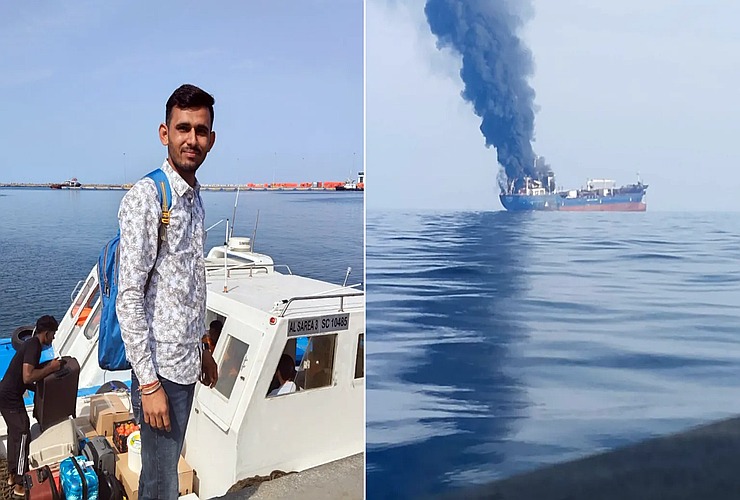
Seafarer Survives Missile Strike Near Strait of Hormuz but Friend Remains Missing
Strait of Hormuz missile strike survivor Sunil Puniya has described the terrifying moment a missile hit the oil tanker Skylight while he was working at sea for the first time.The 26-year-old Indian seafarer said he woke up in panic after hearing massive explosions onboard the vessel during the early hours of 1 March.“I felt the whole ship shake,” Sunil said. “At first, I thought there was a problem with the engine. But when I stepped outside my room, there was another explosion.”The oil tanker Skylight had travelled from Dubai and was approaching the Strait of Hormuz, one of the busiest and most important shipping routes in the world. The vessel became the first commercial ship to be struck after tensions between the United States, Israel, and Iran escalated into conflict in the region.
Missile Strike Causes Chaos on Oil Tanker
At the time of the attack, Sunil was asleep inside his cabin on the third floor of the ship. The missile reportedly struck the engine room, causing a major fire that quickly spread throughout the tanker. The blast led to a complete blackout onboard while thick smoke filled the vessel.“There was smoke everywhere, and people were struggling to breathe,” Sunil recalled. He said several crew members panicked and began making emotional phone calls to their families.“There were sailors crying and calling home. I told them to stop calling and helped bring them up to the deck,” he explained. However, by the time they reached the deck, the fire had already spread across large sections of the vessel.“There was oil everywhere and flames were moving towards us,” Sunil said. “We had no option but to jump into the sea.”
Oman Navy Launches Rescue Operation
The Oman Navy launched a rescue operation shortly after the attack and managed to pull several survivors from the water. However, not all crew members could be located.Sunil later realised that his close friend Dalip Rathore was missing after the rescue operation. “As soon as I realised Dalip wasn’t there, I started panicking,” Sunil said. “I kept thinking about how I would face his family.”Dalip Rathore, 25, had joined the ship one day after Sunil. The two men discovered they came from neighbouring villages in Rajasthan, India, and quickly became close friends during their time at sea. Sunil described Dalip as someone who supported him during difficult moments onboard the ship.“There were network problems on the vessel, so we could not call home often. Dalip became like a brother to me,” he said. Hours before the missile strike, Dalip had taken over Sunil’s shift in the engine room, which later became the direct target of the attack.Dalip and the ship’s captain, Ashish Kumar, were both killed during the strike. While some remains of the captain were recovered, Dalip’s body has still not been found.
Strait of Hormuz Crisis Affects Global Shipping
The attack on Skylight is part of a much larger crisis affecting commercial shipping in and around the Strait of Hormuz. Following the outbreak of conflict involving Iran, the United States, and Israel, Iran responded by restricting access through the strategic waterway.The Strait of Hormuz is one of the world’s most important maritime routes because nearly 20% of global oil and liquefied natural gas supplies pass through the region.According to maritime intelligence company Kpler, dozens of commercial vessels have been hit in or near the Strait since the conflict began.The war has left hundreds of ships stranded in the Gulf region, while more than 20,000 seafarers are reportedly stuck at sea because of ongoing security risks and blocked shipping routes.
Seafarers Face Difficult Conditions at Sea
The International Transport Workers’ Federation (ITF), which supports seafarers worldwide, says it has received thousands of distress calls from crews trapped near the Strait of Hormuz.Many sailors reported problems including unpaid wages, shortages of food and drinking water, unsafe living conditions, and difficulties returning home.Mohamed Arrachedi, an ITF coordinator for the Arab world and Iran, said some seafarers have effectively been abandoned at sea.He shared voice recordings from stranded sailors who said they were running out of basic supplies and had not heard from shipowners for months.The ITF defines abandonment as situations where shipowners leave crews stranded without salaries, food, water, medical care, or assistance.According to the union, more than 6,000 seafarers were abandoned worldwide last year across hundreds of ships. Industry experts say geopolitical conflicts significantly increase the dangers faced by crews working at sea.
Another Seafarer Describes Fear During Conflict
Another Indian seafarer, Rex Pereira from Mumbai, described similarly dangerous experiences while working in the Gulf region during the conflict. Although he was not onboard Skylight, he said he worked under extremely poor conditions for several months before eventually returning home.Rex claimed the crew onboard his vessel had contaminated drinking water mixed with diesel and were forced to eat expired food supplies.When conflict escalated in the region, he said missiles could be seen flying nearby while the ship was positioned close to Iraq.“There was a huge explosion, smoke everywhere, and the ship was shaking,” Rex said.He explained that the crew was terrified and repeatedly contacted anyone they could for help. Eventually, Rex managed to return to India after receiving assistance from a shipping union and the Indian embassy. However, his family reportedly spent thousands of pounds helping cover travel costs.
Questions Raised Over Ship Ownership
Following the Strait of Hormuz missile strike, serious questions have emerged regarding the ownership and insurance status of the Skylight tanker.Maritime tracking platform MarineTraffic lists the shipowner as Red Sea Ship Management, a Dubai-based company.However, attempts to contact the company reportedly failed. Phone calls went unanswered, emails bounced back, and the company appeared to have no functioning website.Neither Sunil nor Dalip’s family members said they had received any communication from the shipowner after the attack.Experts say sanctions on ships transporting Iranian oil have made ownership structures increasingly difficult to trace.Skylight was sanctioned by the United States in December for transporting Iranian oil. After sanctions were imposed, the ship reportedly lost its insurance coverage and registration with a flag state. Without insurance, families of victims may struggle to receive compensation after deaths or injuries at sea. Maritime analysts say many shipowners use complex ownership systems involving multiple companies and countries to avoid responsibility during crises.
Survivor Says He Will Never Return to Sea
Sunil said the experience has completely changed his life and he no longer wants to work at sea again. He admitted he still has not found the courage to visit Dalip’s family after returning home to India.“If I go to his home, I will feel his presence everywhere,” Sunil said.“I miss him a lot.”