

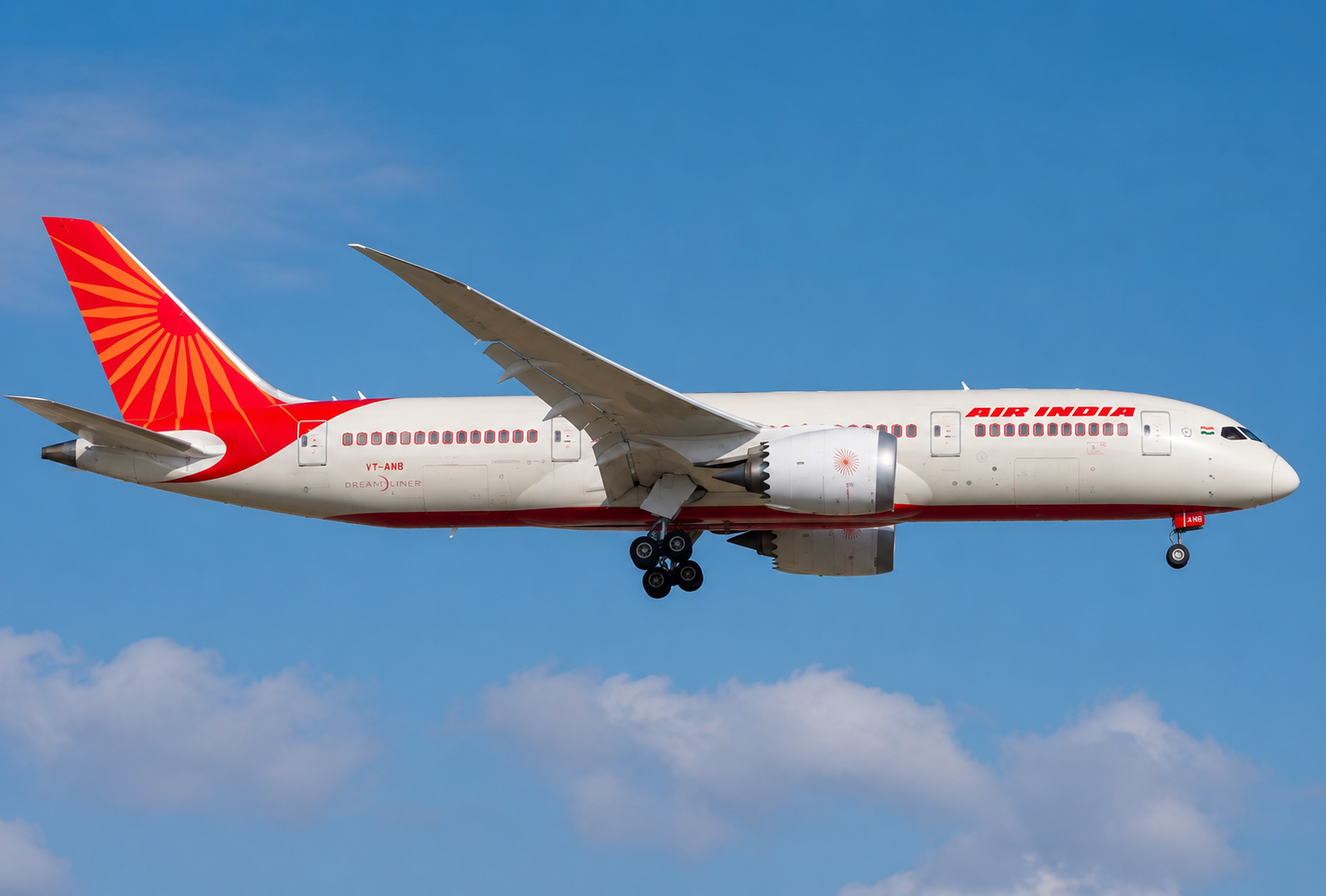
Air India Crash Investigation: One Year Later, Key Questions Still Remain Unanswered
The Air India Crash Investigation continues more than a year after the tragic crash of Air India Flight AI171, with investigators still working to determine exactly what caused one of India’s worst aviation disasters. Although authorities have analysed large volumes of technical evidence, no definitive conclusion has yet been announced.The accident occurred on 12 June 2025, when Air India Flight AI171, a Boeing 787 Dreamliner travelling from Ahmedabad to London, crashed only seconds after take-off. The aircraft struck a medical college complex before bursting into flames, killing 260 people, including passengers, crew members and people on the ground.On the first anniversary of the disaster, India’s Aircraft Accident Investigation Bureau (AAIB) confirmed that the investigation remains active. Officials said work is continuing on flight recorder analysis, aircraft systems, engine performance, maintenance records and human factors before a final report is completed.
Investigation Continues Despite One Year of Analysis
The AAIB released a progress update stating that investigators have made significant progress but are still analysing critical evidence before reaching a final conclusion.
According to investigators, several technical areas remain under examination, including:
- Flight Data Recorder (FDR)
- Cockpit Voice Recorder (CVR)
- Engine performance analysis
- Aircraft system functionality
- Maintenance history
- Crew training records
- Human factors investigation
Officials have stressed that every piece of available evidence must be carefully verified before publishing the final report to ensure its findings are accurate and reliable.
Preliminary Report Raised Important Questions
A preliminary investigation published shortly after the crash revealed one of the most significant findings so far.According to the report, only seconds after take-off, both engine fuel-control switches unexpectedly moved into the “cut-off” position.This action immediately stopped the fuel supply to both engines, resulting in a complete loss of thrust while the aircraft was still climbing.Investigators also disclosed that cockpit audio recorded one pilot asking the other why the switches had been moved. The second pilot reportedly replied that he had not done so.However, the AAIB deliberately chose not to identify which pilot made either statement, leaving one of the investigation’s biggest mysteries unresolved.
Why the Crash Remains So Unusual
Aviation experts describe the accident as highly unusual because crashes immediately after take-off are relatively rare.Although take-off and landing are considered the most critical phases of flight, fatal accidents during the first few seconds after lift-off account for only a small percentage of commercial aviation incidents worldwide.Industry data shows that only a limited number of major jet accidents occur during the initial climb after departure.Because of this, investigators are treating the Air India Crash Investigation as one of the most technically complex aviation inquiries in recent years.
Why Has the Final Report Taken So Long?
Several aviation safety specialists believe the extended timeline reflects the complexity of the investigation rather than any single unresolved issue.Former airline pilot and aviation safety consultant John Cox explained that international aviation rules allow investigators to take additional time whenever more evidence needs to be examined.
According to Cox, investigators must answer several key technical questions before releasing their final findings, including:
- Exactly when both engines began losing power.
- When the fuel-control switches actually moved.
- Whether any technical malfunction occurred before the loss of thrust.
- Whether previous flights revealed similar system behaviour.
Until these questions are fully resolved, investigators are unlikely to issue a final conclusion.
Experts Believe Multiple Possibilities Are Still Being Examined
Former accident investigator Shawn Pruchnicki believes the continued delay suggests investigators are still comparing several possible explanations.He notes that aviation accident investigations often involve testing different scenarios before identifying the most likely chain of events.According to him, if investigators had already established a clear cause, the final report would probably have been published much sooner.Instead, the ongoing analysis suggests several competing theories are still under consideration while technical evidence continues to be reviewed.
Debate Surrounding the Investigation Continues
Unlike many aviation investigations that remain largely technical, the Air India Crash Investigation has generated significant public debate.Following publication of the preliminary report, some international media outlets suggested the cockpit crew may have played a role in the accident because of the fuel-control switch findings.
Those reports sparked strong criticism from:
- Pilot associations
- Aviation safety experts
- Families of the flight crew
- Lawyers representing victims’ relatives
Critics argue that assigning responsibility before the investigation is complete could damage public confidence and unfairly affect those involved.They have called for investigators to focus equally on possible technical, mechanical and operational factors before reaching any conclusions.
Why the Fuel-Control Switches Remain the Biggest Mystery
At the centre of the Air India Crash Investigation are two cockpit fuel-control switches that regulate fuel flow to the aircraft’s engines.These switches are specifically designed with protective locking mechanisms to prevent accidental movement. Pilots normally operate them only during engine start-up, after landing, or in rare emergency situations.Because of these safety features, aviation experts believe it would be extremely unusual for both switches to move unintentionally within seconds of each other.Former airline captain and aviation consultant John Cox reviewed the operational history of several Boeing aircraft families, including the 757, 767, 777, 787 and 737 MAX. According to him, there has been no known case in hundreds of millions of flight hours where a switch malfunction alone caused an engine shutdown.For this reason, investigators continue to study whether the switch movement itself triggered the emergency or whether it occurred as part of the crew’s response to another developing problem.
Were the Pilots Trying to Save the Aircraft?
Some aviation specialists believe the movement of the fuel switches may not have caused the accident but instead reflected the crew’s attempt to recover the aircraft.According to aviation analyst Simon Hradecky, Boeing’s emergency procedures for a dual-engine failure require pilots to move the fuel-control switches to the “cut-off” position before returning them to “run” in an effort to restart the engines.If the engines had already begun losing thrust because of another issue, the pilots may have been following this emergency checklist during the aircraft’s final moments.Under this interpretation, the switch movement would represent an emergency recovery attempt rather than the original cause of the power loss.Investigators have not confirmed either explanation, and both possibilities continue to be examined.
The Ram Air Turbine Raises More Questions
Another important aspect of the Air India Crash Investigation involves the aircraft’s Ram Air Turbine (RAT).The RAT is an emergency backup system that automatically deploys when both engines fail or when the aircraft loses normal electrical or hydraulic power. Once deployed, it provides limited power to essential flight systems.According to the preliminary report, the RAT became operational only a few seconds after the engines lost fuel supply. However, some aviation specialists argue that simulator testing suggests the deployment timeline may not completely match the sequence described in the preliminary findings.This has led investigators to closely examine whether the engines had already begun losing power before the reported movement of the fuel-control switches.The AAIB has not commented publicly on these technical questions while the investigation remains ongoing.
Did an Electrical Malfunction Play Any Role?
Some independent aviation researchers have suggested another possible explanation involving the aircraft’s electrical systems. One theory proposes that an unexpected electrical fault may have temporarily affected the aircraft’s flight computers, potentially influencing engine management systems during take-off.Supporters of this theory believe investigators should carefully examine whether any system malfunction occurred before the apparent fuel interruption.However, the preliminary report did not identify any evidence of a major electrical failure.Instead, investigators stated that the Boeing 787 held a valid airworthiness certificate, complied with required maintenance standards and had completed all mandatory inspections before the accident.At this stage, authorities have not confirmed any link between electrical systems and the crash.
Engine Performance Still Under Examination
Although both General Electric GEnx engines had accumulated thousands of flight hours, investigators noted that they remained well within their certified operational lifespan.Because simultaneous engine failures are exceptionally rare in modern commercial aviation, specialists continue to examine every aspect of engine performance.Investigators are analysing data from the aircraft’s Flight Data Recorder and engine monitoring systems to establish the exact sequence of events during the final seconds of flight.Experts believe important clues may come from engine temperature readings, fuel-flow data and thrust performance immediately before impact.This detailed technical analysis could help determine whether the engines began losing power before or after the movement of the fuel-control switches.
Cockpit Voice Recorder May Hold the Final Answers
Investigators have confirmed that the Cockpit Voice Recorder has been successfully recovered and fully transcribed.However, only a small portion of the cockpit conversation has been made public.Aviation experts believe the complete recording, when analysed alongside flight data, may provide the clearest understanding of what happened inside the cockpit during the aircraft’s final moments.Until the full analysis is complete, investigators have declined to speculate on responsibility or identify any individual actions that may have contributed to the accident.
Conclusion
More than a year after the tragedy, the Air India Crash Investigation remains one of the most closely watched aviation inquiries in recent history. While investigators have gathered extensive technical evidence, several important questions remain unresolved, including the sequence of events involving the fuel-control switches, engine performance, emergency system activation and cockpit communications.Authorities have repeatedly stressed that no final conclusions should be drawn until every aspect of the investigation has been carefully examined. The final report is expected to provide a comprehensive explanation of the crash and may include safety recommendations aimed at preventing similar accidents in the future. Until then, investigators continue to analyse evidence while families of the victims, aviation professionals and the wider public await definitive answers.